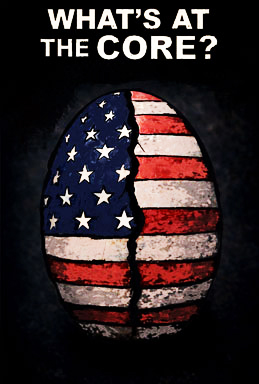
The stress test is over. The old story that the Constitution is amendable and self-correcting has proven to be false. The belief that federal institutions can't be weaponized contradicts what people can see with their own eyes: masked agents on American streets, black box detention centers, and a steady conversion of public life into a permanent state of fear.
You do not need complicated theories, a degree in political science, or to listen to every trending political podcast to see the oppression unfolding in plain sight. When what is objectively wrong becomes organized, funded, and repeated until it becomes policy, we must stand up against it as the tyranny it is and say NO.
No to our deplorable so-called leaders. And that goes for all of them. Not just the cartoon villains in the current administration and its game-show-host president; not just the party you already distrust. The cruelty is bipartisan.
When people say the center will hold, they mean, the core institutions and shared norms of a society will stay intact under pressure, that even if things get tense, the mainstream politics, rule of law, and everyday social cohesion won't collapse into chaos or extremism. If a woman getting shot in the face going unpunished is the center holding, we must ask what exactly is the center holding and for who?
The world, as we thought we knew it, is collapsing and we each have to find our path to process the crossing of this threshold. When I say process it doesn't mean some clever framework or a new vocabulary word. It means surviving the daily cognitive dissonance of living inside a system that asks you to call assault security, asks you to call revenge policy, and says that your despair is simply how it's always been. It's important to remember the courage it takes just to live in this corrupt system and still want to fight for what's right, the heroics it takes to maintain hope for a better world. Yet we spend our time just trying to survive, we are too tired to fight the big fights.
That resistance fatigue is not an individual failure. It's part of the design.
It is a sensitive time in America. We are tired in a particular way, we are not only exhausted by events, but exhausted by the constant demand to interpret them, to decode them, to argue for what our eyes and bodies already know. We are told to wait for the facts while the facts are happening to us. We are told to trust the system while the system stampedes right over us.
And in that exhausted atmosphere, old myths get recycled as common sense, especially myths about freedom.
For decades, I remember hearing this refrain often, its the most common gun advocate story told as justification for the Second Amendment which has always been a prophecy, and it goes something like this; One day a corrupt government might invade your home, and you will need to defend yourself, and that is why you have the right to bear arms. It's a fable about defense, a story where the armed citizen is the last barrier between ordinary life and state tyranny.
And now, in the most grotesque inversion, many of the same people who rehearsed that fear as a justification for their guns have become aligned with the type of mobilized fascist apparatus they claimed to be shielding themselves from. Those same people did not realize that they would be the ones recruited to illegally arrest people with violent force.
The imagined tyrant is no longer this perceived evil government as such, it's the immigrant, the neighbor, the protester, the outside agitator, and the poor person who simply wants to be treated with dignity.
The Second Amendment story always claimed it was about resisting a government that had turned predatory. The prophecy indeed is being fulfilled as there are armed men grabbing people off the streets. There are currently agents using the full weight of the state against defenseless people in our communities in the form of ICE agents and large parts of the gun-rights culture treat it not as tyranny but as reassurance. They don't see state abuse of power, they see their team winning.
We have arrived at the moment when a political identity built on supposedly anti-government sentiment reveals its real center, not opposition to state power, but a desire to control who state power is used against.
This is why the old rhetoric justifying the Second Amendment being about defending freedom rings hollow, because they are treating freedom as a private possession and not a shared condition.The government is going to come into your home was always more reality for some people than others - Black families, immigrants, the poor, the people who have historically suffered the assaults.
The weaponization of Immigration and Customs Enforcement is not an aberration, it is modern law enforcement in its distilled form. Reports on ICE's current expansion show a wartime recruitment type push, a mass-hiring campaign aimed at gun shows, UFC events, and NASCAR races. Within a right wing media eco system ICE is able to obtain a dataset to target people they determine are military fans and sign them up to be agents, complete with loosened requirements and huge signing bonuses.
Trump is a brand, the mission is recruitment, and the enforcement is sold as spectacle.
One of the most insidious things about Trump's ICE agents is that this is being done as much to punish certain people as it is to shore up support from others. It's enforcement as political theater. Raids and removals not only disappear people, they manufacture a public mood, a spectacle of power designed to reassure a specific chosen audience. The operation becomes a steady drumbeat of intimidation for some, and a performance of dominance for others.
The trouble is not that people can't see the brutality for what it is. The trouble is a culture that teaches apathy, then sells it back as sophistication in a media frenzy engineered to produce mistrust in each other, mistrust in institutions, and finally mistrust in our own moral instincts, so that when the boot comes down, we argue about whether it was legal instead of whether it was right.
In the middle of all this orchestrated chaos how do we find equanimity? How do we maintain hope?
There is a Bjork song where she sings hope is a muscle. Hope isn't a feeling you wait around for; it's something you exercise, something you practice until it can carry weight.
So today I remind myself to work on my hope: my hope that we end this mess and that on the other side of it we continue to fight for, and find, a better future.
In the practice of hope, I'm going to post regular pieces here to give voice to the voiceless, and to bring conflicting views into the same room long enough to actually talk. The plan is to make a place where uncertainty can be shared without fear - where together people can argue, learn, and imagine what another world could look like.
There is a common temptation, particularly in moments of public horror, such as the killing of Renee Nicole Good, to treat Immigration and Customs Enforcement as a novel or unforeseen problem. As though it is a rogue agency, an especially grim extension of a policing system we already live under, but somehow new in its lawlessness. However, ICE is not an exception; it is American policing in its distilled essence. A regime that expands coercive power will, by design, produce coercive outcomes. This is the underlying logic.
ICE represents American policing stripped of its civic costume and reduced to its essential functions: aggression and punishment. Established in 2003 as part of a sweeping federal reorganization under the newly created Department of Homeland Security, ICE was born from the increasing militarization of domestic policing following September 11, 2001 as a tool of state enforcement, an institutional weapon. Through federal grant programs, local police departments became recipients of military-grade equipment and military ideology, fundamentally altering the relationship between civil society and law enforcement.
Between 2001 and 2020, states received at least 50 billion dollars in federal grants to purchase military-grade equipment. When a society invests in the apparatus of war, it acquires not only material but also a worldview. It trains its institutions to perceive the public as a potential threat. It normalizes escalation and interprets it as readiness.
This is how militarization becomes embedded in everyday life. In Fargo, North Dakota, one of the statistically safest cities in the United States, police patrols were outfitted with military-style assault rifles. Not because Fargo required such weaponry, but because, once the equipment pipeline opens, the gear arrives first and the justification follows later.
To understand how ICE operates, and to debate the underlying ideologies of its agents, one must begin with the institution's job description. If ICE is a distilled form of the police, then the more fundamental question is this: what is the role of police in modern society? If it is relatively uncontroversial to argue that ICE ought to be abolished, then this raises a more profound question, should the broader institution of policing, in its current form, also be subject to abolition?
Modern police forces emerged historically alongside capitalist development as specialized systems for managing labor unrest, dissent, and rebellion. In the United States, this repressive function was never race-neutral or class-neutral. Mechanisms of labor control and racial subjugation are foundational to the institution's development, from slave patrols to strike-breaking. The central purpose of policing, historically and structurally, has been to maintain social order on behalf of dominant economic and racial hierarchies.
The state refuses to guarantee housing or healthcare but it will promise punishment for those who fall through the cracks. The refusal to meet basic needs is supplemented by a commitment to manage the fallout through force. And the more structurally unequal society becomes, the more necessary this force appears.
According to Mapping Police Violence, 2024 marked the deadliest year on record, with at least 1,365 individuals killed by United States law enforcement. Preliminary data indicates that 1,315 people were killed in 2025. In a nation that publicly insists policing is about safety, these figures are not aberrations. They are signals. They indicate the scope of what the institution is permitted to do, openly and repeatedly, to sustain the existing social order. This is not a malfunction. It is a feature of a system authorized to escalate more quickly than it is permitted to exercise care.
ICE inherits and modernizes this role. While a municipal police officer is authorized to interpret behavior as suspicious, an ICE agent is empowered to determine removability. The logic of intervention is not centered on public safety but on social extraction. And this extraction is not metaphorical. In the first ten days of January 2026, four individuals died in ICE custody. Multiple outlets have reported that 2025 was the deadliest year in ICE detention in over two decades. These are not isolated incidents or the result of a few dysfunctional facilities; they are evidence of a system operating as designed, treating people as security threats and not humans with rights.
The primary justification for these practices is economic. Repeated claims, such as the assertion that undocumented immigrants who commit no crimes must be deported because they strain healthcare systems and take jobs, are rhetorically effective but empirically false. The United States does not offer universally free healthcare in the manner these talking points suggest. Moreover, the narrative of job theft distracts from the precarious structure of the labor market. If employment can be displaced so easily, the issue lies not with the immigrant but with an economic order that renders workers disposable, health benefits optional, and stability a privilege.
This scapegoating narrative functions to deflect public anger away from those who design and benefit from exploitative economic arrangements and toward vulnerable populations.
President Trump, in characteristically reductionist and inflammatory terms, made this point explicit. Deportation as a solution to economic hardship is largely symbolic. It serves not to resolve the complexities of immigration or border security, but to discipline the public, channel resentment, and affirm state power. Force and punishment fill the void where housing, healthcare, and education should be. The resulting damage is then rationalized as the cost of freedom.
If the institution of policing, in its current form, is already untenable, then ICE simply takes that dysfunction and accelerates it. It operates with fewer local ties, fewer constraints, more secrecy, and more access to federal funding. The use of national security language provides it with ideological legitimacy. As a result, it increasingly resembles the historical forces of state violence from which American mythology claims to distance itself.
Political leaders frequently claim that the problem is the people and not the system. They assert that the problem is a handful of bad agents, corrupt leaders, or exploitative billionaires. And while such individuals do exist, that is precisely the point. A society with institutional integrity would construct systems designed to prevent corrupt or violent actors from gaining power easily. Yet the current system appears to do the opposite. It creates channels for corrupt leaders, normalizes their worldview, and protects the institutions they control. When predictable harm occurs, the public is asked to treat it as an exception rather than as a product of the system's design.
In the 1967 film Cool Hand Luke, there is a moment when the prison warden escorts Luke to solitary confinement and attempts to soften the blow with the phrase, I'm just doing my job. Luke responds, Callin' it your job don't make it right. This exchange encapsulates how oppression reproduces itself but doesn't mean the rest of us should tolerate it. Accountability is essential, and police officers must face consequences when they break the law. However, the issue is not merely a matter of distinguishing between good cops and bad cops. Rather, it is crucial to address the structural roots of the problem by focusing not on individual names, but on the institutional power represented by the badge.
Those who join the police force, who take an oath to serve the public, can also be understood, in some cases, as victims of a system that entraps them. Many enter the police academy with a desire to help their communities, only to find themselves upholding a system that perpetuates injustice. This contradiction reveals how capitalism can absorb even well-intentioned individuals, placing them in roles that ultimately serve interests contrary to the very communities they hoped to empower.
Focusing solely on individual guilt is also how the system survives. A few careers are sacrificed, a new training is introduced, or a new camera is installed, and yet the core functions remain unchanged. This is why police reform so often fails to reduce state violence. Instead, it frequently results in expanded budgets, expanded technology, and expanded jurisdiction, all of which are then marketed as accountability. These reforms add layers of procedure and redefine them as progress, while leaving the power structure untouched.
This leads to a question that inevitably follows: if we do not have police, what alternatives do we have?
The answer is already visible. Most harm is managed not by police, but by families, neighbors, coworkers, and informal community structures. People intervene, de-escalate, support, and protect one another without legal authority or having officials present. Police typically arrive after harm has occurred, and often escalate situations that could have been managed through nonviolent means. Many individuals hesitate to call law enforcement at all, having learned through experience that such calls can convert a problem into a catastrophe. When one looks even further upstream, it becomes evident that many of the harms associated with crime originate in legislative and economic decisions - laws passed on Capitol Hill that generate social distress and enable cycles of violence. The police are then used to enforce the very consequences those laws create, retroactively validating their own necessity.
Communities frequently endure harm and resolve it on their own, with no satisfying resolution provided by law enforcement. The argument is not that assistance is never needed, but that the badge is not the core of public safety. Empirical evidence shows that safety is more often local, relational, and cultivated long before a siren is heard.
Historical precedent confirms this. During uprisings, labor strikes, and natural disasters, communities have formed ad hoc systems of care and coordination out of necessity. These moments are not utopias, but they reveal a critical insight: policing is not a metaphysical necessity. It is a political choice. And that choice should be subject to democratic scrutiny.
To rebuild, rather than reform, begins with the refusal to treat armed forces as the default response to social problems. It requires the reallocation of resources toward housing, healthcare, education, and the basic infrastructure of dignity. These are the institutions that prevent instability from erupting into crisis. It also requires acknowledging the embedded gaps in American governance. Police lack full understanding of the laws they enforce. Courts are disconnected from the communities they judge. The elite ruling class who write the laws do not obey the law, and they all remain insulated from the citizens most affected by their decisions.
Abolition is not merely the removal of harmful institutions. It is a strategy for constructing alternative systems of safety that do not rely on cages, raids, or funerals to function.
To believe that ICE can be reformed is to misunderstand its fundamental purpose. And this recognition leads to a deeper question: what kind of economic system requires this level of violence to maintain legitimacy? If capitalism depends on coercive force to preserve its structure, then the idea of abolishing coercive institutions may not be an outlandish distraction from systemic change. It may, in fact, be the first necessary step.
ICE not only helps us see our law enforcement more clearly, it should also force us to look at our military more clearly. The methods used to discipline migrants at home mirror the methods the United States has used abroad for decades, from Iraq to Afghanistan to Central America, where entire populations were forced to live inside Washington's definitions of order.
The shock is not that America is the face of global aggression, it's that its face has turned inward, and not just toward the usual targets of police violence: Black people, immigrants, and the poor, those who always knew this type of state condoned violence was simply a matter of time. What so many once believed was confined to the shadows, or to films about fascism and war, now unfolds in broad daylight on American soil.
And to our collective horror, they shot an innocent woman in the face. Her name was Renee Nicole Good. Her identity as queer, defiant, and unafraid became the silent justification. Her queerness made it easier for many to look away. Racism, homophobia, and the rituals of scapegoating guard the institutions of power, redirecting every reckoning.
When the United States can launch a military operation to seize a foreign head of state, and justify it, openly, as law enforcement, and for the purpose of leveraging oil, you see the same game plan at work: force instead of diplomacy, extraction instead of policy.
At the core of modern American society is violence, not as an accident, not as the result of a few bad actors, but as a governing instrument. And if we don't confront that, we will keep mistaking symptoms for causes. We will keep asking how individual agencies went wrong, instead of asking why coercion remains the default language of the system itself.
That's where the immigration narrative matters, not because immigrants are the problem, but because immigrants are the scapegoat that keeps the system from being named. The empirical evidence is clear: undocumented immigrants are not responsible for violent crime at higher rates than native-born citizens. In many cases, they commit crimes at significantly lower rates. This holds nationally, in Texas data where immigration status is tracked, and in New York, where immigration rose as crime rates fell. Panic consistently outruns evidence.
So why is the myth so durable? Because the myth is useful. It converts structural anxiety into a human target. Migration does not occur in a vacuum. People do not flee their homes for no reason. They flee poverty, violence, climate collapse, conditions the U.S. helped create through coups, economic destabilization, and a century of corporate extraction across Latin America. But telling that story would require a painful confession: that what looks like chaos is often the system working as designed.
If we really wanted to solve migration as a human problem, we would be talking about rebuilding conditions for dignity. America would allow Central and South American countries to enrich themselves off their own resources, not expand the machinery of refugees.
A capitalist society that concentrates wealth upward needs a coercive arm to manage the downward fallout. It needs a story to blame individuals instead of institutions. It needs ICE to translate displacement into security. And it needs a media ecosystem to translate all of it into action.
This raises a deeper question than how people were convinced to tolerate tyranny. Many have not tolerated it at all. Protests against ICE and police brutality have stretched on for years, even as conditions actively worsen. The more uncomfortable question is this: what story were people already telling themselves that made this tyranny feel necessary?
There is no plausible way to wage two decades of foreign wars across a dozen countries, deregulate gun laws in the face of constant mass shootings, and saturate a culture with violent films and video games simulating war, without expecting those forces to manifest themselves at home.
When you strip away public broadcasting and defund access to independent, fact-based information, you create a landscape where people's views on institutions like ICE are shaped by bias and misinformation.
We are fed a steady media diet of violence presented to us as competence. From childhood onward, we were fed stories in which force was the only serious response to conflict. Cop shows taught us that the law is an inconvenience, and violations are justified by a hero's intentions. War films taught us that morality lives inside the gun barrel. Even when power is portrayed as corrupt, we're invited to empathize with it.
This matters because systems don't run themselves, they require people. ICE scales its brutality not only through congressional budgets, but by recruiting from a population already primed to accept violence as necessity. These agents emerge from a precarious economy, social isolation, and a corporate media ecosystem that teaches violence as the only viable language of power in a life emptied of integrity.
The Pentagon's relationship with Hollywood is not folklore, it is policy. Cooperation is exchanged for access to equipment, locations, and personnel. Scripts are shaped. Spectacles are subsidized. The same pipeline extends into gaming and recruitment. The Army did not merely benefit from video-game culture, it embedded itself within it. Entertainment became education and rehearsal. ICE agents are cosplaying their way into the dark shadows of history.
In old sci-fi films, they warned us about chips in our brains and robotic policemen. They were wrong about the details, but right about the outcome. No chips were implanted in our brains because we volunteered to carry the tracking devices in our pockets. And why spend money to build robocop when you can train people to think like machines? It's more reliable than robots, cheaper than drones, easier than dissent. Once people are trained to internalize surveillance, the system no longer needs to impose itself, the system sustains itself.
Humans are motivated by survival and fear, but we are sustained by hope, care, and connection. Sigmund Freud, in Civilization and Its Discontents, suggests that civilization develops in parallel with the development of the individual. But that presumes society has a center, a moral or psychological core from which it grows and must survive. What if that assumption is wrong? We are wired for empathy and shared meaning, but society is not built in our image. It has only institutions, structures, and channels of information. Society is not organic; it becomes what it rewards. If cruelty is rewarded, cruelty becomes normal. If fear is rewarded, fear becomes common sense. If domination is rewarded, domination becomes a way of life.
The core of society is fluid. It can change, it can become what we make it. It is not inherently good or evil. Society either works for the few, or for the many, or it collapses. Right now, we live in a system designed to favor the few, and the chaos, torture, and violence the state will unleash to keep it from collapse will surpass anything imagined by a movie studio.
That sounds bleak until its inverse becomes visible. If systems can be engineered to enrich the few, they can be redesigned to protect the many. Our capitalist system's efficiency at concentrating power is evidence of human capacity to build systems, not evidence that systems can't be changed. The fact that the system works, just not for us, is not a reason to despair, it is a reason to believe that other systems are possible.
This is where hope enters, not as sentiment, but as practice. As Bjork sings, Hope is a muscle, then it must be exercised. Our strength builds with the conversations we're still allowed to have, if we're brave enough to hold them. We cannot rebuild anything if we cannot speak with each other. And we cannot speak if every conversation is a battlefield, if every disagreement is framed as a threat.
Do I believe the police should be abolished tomorrow? No. But I believe abolition debates matter because they get us to pose honest questions. What are police for? What actually prevents harm? We must ask ourselves, in times like these, what false beliefs are we still holding on to? What conversations are we avoiding, and why?
Hope is not the yolk; it is the fragile shell of the egg. It is the thin layer holding it all together. There is no solid center holding society in place. The weight is carried by those at the margins, the exploited, the dispossessed, and the ones who believe in a better future for all.
There is no center that will save us. There is only what we build, defend, and practice together.
If violence is at the core of the system, then we must stop acting shocked when coercion is its response. We must stop allowing propaganda to replace experience and fear to replace solidarity.
We must do the one thing authoritarian capitalism fears most: speak plainly, outside the approved scripts, long enough for you and I to become a we.
Because that is what's at the core of every revolution worth the name.